From My Seat at the Cello by Martha Brons
Posted by Ruth Brons on Feb 1st 2019
(This article appears in our Healthy Playing - Healthy Studio Booklet, which is FREE WITH PURCHASE as resource to string teachers. Limit One Booklet per purchase.)
At the First International Cello Convention, Leonard Rose referred to the cello as “our beloved instrument.” Sharing my passion for music has made teaching the cello a true labor of love.
Seeing students from 50 and more years ago still doing our thing, playing cello, is a great joy to me. Some are doctors, professors, lawyers, even a judge, teachers and some professional musicians. To play in good health for a lifetime is a reasonable goal, both for me and my students.
Margaret Rowell often said “Cello playing is easy.”
These are some of my thoughts for any age to form easy, healthy playing.
Big Stuff - Sitting
Hours of sitting in practice, rehearsals, and performances over 60 or so years have made me decide that sitting posture is of prime importance in healthy playing. Cello players come in many sizes and conformations compared to the relatively few sizes of cellos.
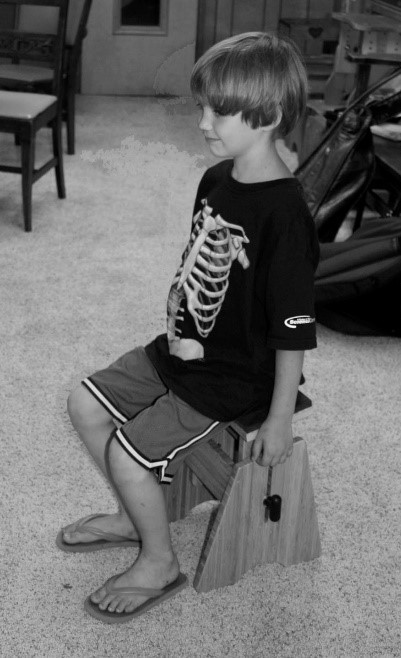
Carson sits on slanted prototype bench from Frances Rowell.
In teaching cellists from 4 year old beginners through college students, getting each student comfortable with his or her cello is sometimes most perplexing. I have found that it is better to have the student seated comfortably before trying to get the cello into position.
This requires a chair or bench about knee height, either flat or at a slight forward angle, so that both feet are flat on the floor. A nice tall back is then supported from the feet. The knees are far enough apart to support the cello at its widest. I prefer an almost square set to the cello. I will often hold the cello and try to get the knees and the scroll into good positions before determining the length of the endpin. With my youngest students, it is hard to figure out the correct instrument size without doing this. Small size cellos are not so standard in size. As students grow into adulthood their proportions sometimes change, so keep checking.
Since I started playing cello in the 1940’s the name has gradually changed from “violoncello” to “ ’cello” to the current “cello,” but nothing has changed so much as our endpins. They have gotten longer, and are available in several angles which are great for our long-legged boys and girls. Kids have gotten bigger! The New Harmony angled endpin has proved very useful.
As I worked with student after student, I made posture changes of my own. Supporting the back from the feet up frees both arms to move where required and allows hands to remain supple and free to move. Cello playing became easier for me – and my students!
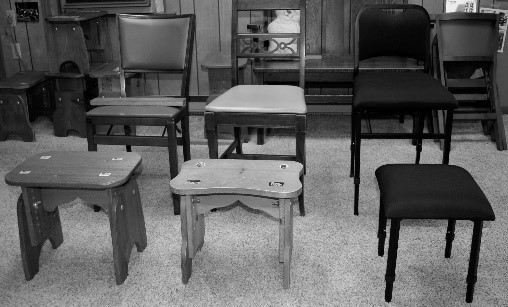
Making your chair or bench slanted a bit forward will help everyone to have a taller back. This can be done with a special chair or by placing a 1“block of wood under the back legs of the chair or bench. Many stages have the Cello Chairs by Wenger. These come in several heights, but it is expensive to buy just one for your studio. You might consider the ADJUSTRITE Musician's Chair by Vivo USA. This is a folding chair, it is a space saver.
Benches and chairs in my studio.
More Big Stuff – Right Hand
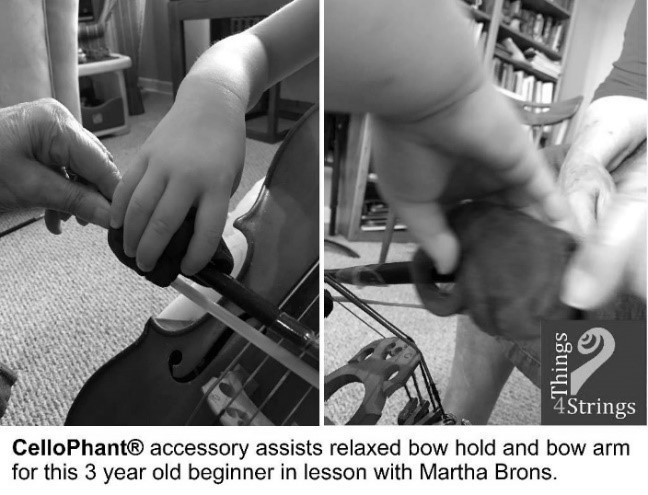
Many cellists also get a callous on the right thumb. An emery board can keep this from becoming too large.
- Finger nails can be too long. In thumb position, they must be very short. Again, an emery board can be very helpful.
- Nails that split can be helped with a product called “Hard as Nails,” made by Sally Hanson. Minor skin injuries can be covered with “New-Skin Liquid Bandage”, by New-Skin.
The bout of the cello can be uncomfortable around the left knee. The best solution I have found is to buy a chamois skin at an auto supply store and cut it into 10 to 12 inch squares and place over the left leg to protect the knee. This soft leather drapes and stays in place.
I hope that some of these thoughts will allow our students and ourselves many years of exploring the treasures of the cello literature: symphony, opera, ballet, chamber music, as well as finding new directions for our magnificent and versatile cello.
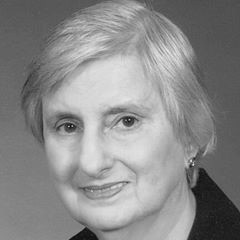
Martha Brons speaks from long teaching and performing experience. She is the recipient of the South Carolina Studio Teacher of the Year in 2008. She holds her B. Music in Cello Performance from the University of Illinois, 1955, and her M. Music in Cello Performance from the Philadelphia Musical Academy. Mrs. Brons performing experience includes being soloist and principal cellist with the Haddonfield, NJ, Symphony, free-lance cellist in the Philadelphia area and being a member of other orchestras. She founded and performed with the Heritage Chamber Players in Greenville, SC, for 20 years. Her teaching experience includes levels from elementary school through university, all the while maintaining her Brons Cello Studio. She has attended numerous Suzuki Institutes and Conventions, including one in Matsumoto in 1982. She has observed and studied with Tanya Carey, Gilda Barston, Nancy Hair and many other artist teachers. Her former students perform in many orchestras and other places. A few, like April Reed, Sharon Mulfinger and Adam Maalouf have their own web sites and are exploring new directions in cello performance.